How to Read Key Signatures
A key signature is the group of sharps or flats printed at the start of every staff, and it names two keys at once: a major key and its relative minor. There are fifteen. Two short rules cover all of them. This is the same sequence taught in the printed Key Signature Reference Guide, with sound and self-tests added.
- Sharp keysTake the last sharp printed and go up a half step. Four sharps end on D♯, so the key is E major.
- Flat keysThe second-to-last flat IS the key. Four flats read B♭ E♭ A♭ D♭, so the key is A♭ major. (F major, the one-flat key, is memorized on its own.)
- MinorCount a minor third down from the major key. The signature does not change — only the home note does.
The rest of this page shows why each rule works, where every accidental sits, and the mistakes that cost marks. Jump to the rules in full →
Learning Objectives
- I can explain how to find the major key from a sharp signature
- I can explain how to find the major key from a flat signature
- I can explain how to find the minor key from a sharp signature
- I can explain how to find the minor key from a flat signature
- I can explain the correct placement of all seven sharps and flats
- I can notate a sharp signature and a flat signature properly
- I can recite the number of sharps or flats for any major or minor key
- I can recite the major and minor key for any number of sharps or flats
- I can recite the sharps or flats in the signature for any major or minor key
1 What Are Key Signatures?
Just as a person’s signature identifies them, a key has a key signature that identifies it: the group of sharps or flats printed at the start of every staff. It does two jobs.
- First, it sets the key once. Every marked note stays sharp or flat for the whole piece (unless an accidental ♯, ♭, or ♮ says otherwise), so the music isn’t cluttered with repeated accidentals.
- Second, it names the key. You read the notes, phrases, and passages with that key in mind.
Why it matters
A signature lets you recognize a key at a glance. Instead of a random scatter of sharps or flats, you see an organized system that points straight to the key. Knowing the key also helps a performer make informed decisions about how to treat specific notes and phrases. (Telling whether a piece is in the major key or its relative minor, by sight or by ear, is a separate skill, and not one this page covers.)
How to read a signature
Every printed signature names two keys: a major and its relative minor. Count the sharps or flats and recall the key that count belongs to. The goal is to know them, not count them. Soon you’ll see three sharps and instantly think A major / F♯ minor, and because the order of sharps never changes, you’ll know those three sharps have to be F♯, C♯, G♯, in that order.
2 The 15 Key Signatures
| Sharps / Flats | Major Key | Minor Key | Accidentals (in order) |
|---|---|---|---|
| None | C major | A minor | — |
| One Sharp | G major | E minor | F♯ |
| Two Sharps | D major | B minor | F♯ C♯ |
| Three Sharps | A major | F♯ minor | F♯ C♯ G♯ |
| Four Sharps | E major | C♯ minor | F♯ C♯ G♯ D♯ |
| Five Sharps | B major | G♯ minor | F♯ C♯ G♯ D♯ A♯ |
| Six Sharps | F♯ major | D♯ minor | F♯ C♯ G♯ D♯ A♯ E♯ |
| Seven Sharps | C♯ major | A♯ minor | F♯ C♯ G♯ D♯ A♯ E♯ B♯ |
| One Flat | F major | D minor | B♭ |
| Two Flats | B♭ major | G minor | B♭ E♭ |
| Three Flats | E♭ major | C minor | B♭ E♭ A♭ |
| Four Flats | A♭ major | F minor | B♭ E♭ A♭ D♭ |
| Five Flats | D♭ major | B♭ minor | B♭ E♭ A♭ D♭ G♭ |
| Six Flats | G♭ major | E♭ minor | B♭ E♭ A♭ D♭ G♭ C♭ |
| Seven Flats | C♭ major | A♭ minor | B♭ E♭ A♭ D♭ G♭ C♭ F♭ |
The accidentals are listed in order. Each row keeps the ones above it and adds the next from the order of sharps or flats.
Three pairs sound identical but are spelled differently — D♭/C♯, G♭/F♯, and B/C♭. Twelve sounds, fifteen written signatures.
3 All 15 Signatures, Notated
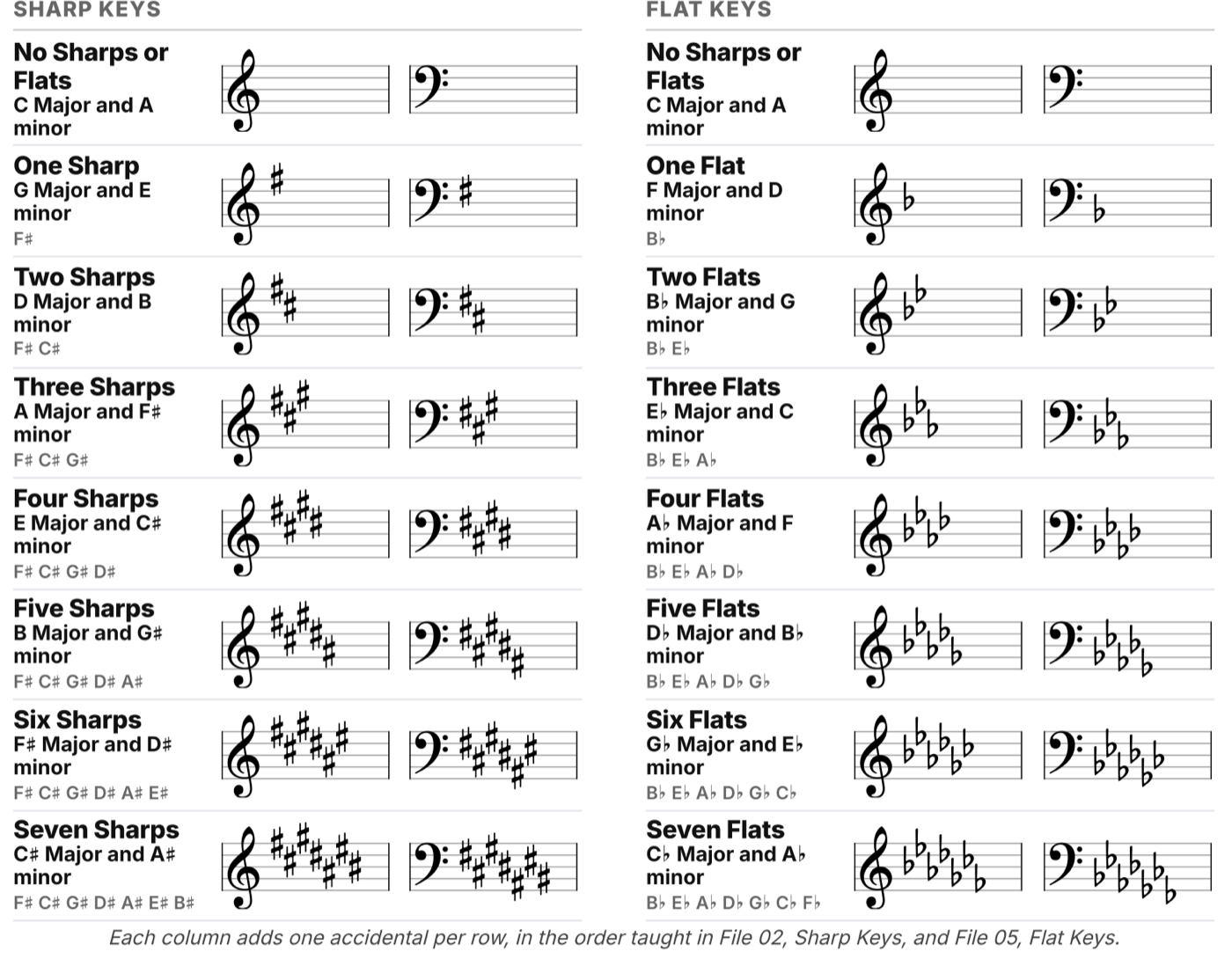
Every signature on the staff, in both clefs, with both key names. Sharp keys read down the left, flat keys down the right. Both columns start from C and add one accidental per row.
4 The Order of Sharps & Flats
The order of sharps — the 2-3-2 diagonals
F C G D A E B — “Father Charles Goes Down And Ends Battle.”
Sharps are added in one fixed order: F♯ C♯ G♯ D♯ A♯ E♯ B♯. On the staff they fall into three diagonals, each sloping down to the right: F♯–C♯ (two), then G♯–D♯–A♯ (three), then E♯–B♯ (two). That 2-3-2 shape has an upward jump between the groups.
The order of flats — the zig-zag
B E A D G C F — “Battle Ends And Down Goes Charles’ Father.”
The flats use the reverse order, B♭ E♭ A♭ D♭ G♭ C♭ F♭, and each new flat zig-zags up then down the staff. Together they make the full seven-flat signature, C♭ major.
It never changes — not the notes, and not where the accidentals sit on the staff. Every sharp signature draws from the front of F C G D A E B; every flat signature from B E A D G C F. Learn these two lists and most of the work is done.
Before going on to how the accidentals are drawn, check that the counting works. Read the signature, count the sharps or flats, and name the major key. If you have to think about it, that is exactly what the drilling in section 11 fixes — and the rules are spelled out in section 8 if you want them first.
5 Where Each Sign Goes on the Staff
Each sharp or flat in a key signature is written in one fixed octave, and it never changes. In treble clef the F♯ is always on the top line, never the bottom space.
Right vs. wrong: G major’s sharp
- The F♯ belongs on the top line — the F above middle C.
- Here it sits in the bottom space, a different F an octave lower.
- Every accidental in a signature lives in one fixed octave. Move it and this is no longer G major.
Right vs. wrong: B♭ major’s flats
B♭ major’s signature is two flats: B♭ on the middle line, E♭ in the top space. Get one accidental right and the other out of place, and the whole signature is wrong.
- B♭ is correct, on the middle line.
- E♭ belongs in the top space. Here it has dropped to the bottom space.
- Getting one right does not help: a signature is wrong unless every accidental is placed correctly.
Every accidental in a key signature sits within the five staff lines: key signatures never use ledger lines.
6 Centering the Sign on Its Line
Placement has to be exact. The center of a sharp must sit on the very line or space of the note it alters; the loop (belly) of a flat must do the same. A sign floating between a line and a space, not clearly on either, is a novice mistake.
- The sharp is far too large for the staff.
- Its centre no longer sits on the top line, so it is not clearly marking F.
- A reader cannot tell which line is meant — which is the sign’s only job.
- A flat’s loop (belly) must sit exactly on the line or space of the note it alters.
- Here it floats between the middle line and the space below it.
- Is it B♭ or A♭? Unreadable, so it is wrong.
Tie to grading: on the worksheets, an accidental in the wrong place is marked wrong.
7 The Order Never Skips
Because the order never changes, every signature is just the front of that list. One sharp is F♯; two is F♯ + C♯; three is F♯ + C♯ + G♯. You can never have a G♯ without F♯ and C♯ already in front of it, and never an E♭ without B♭ first. A later accidental with an earlier one missing isn’t a real key signature.
- Accidentals are always added in their fixed order — flats: B♭ E♭ A♭ D♭ G♭ C♭ F♭. (Sharps just the same: F♯ C♯ G♯ D♯ A♯ E♯ B♯.)
- E♭ is the second flat, so B♭ must already be present.
- The order never skips — a signature is always the front of that list, never a later item on its own.
8 Naming the Key: Major & Relative Minor
This is the part most people come for. Two rules name the major key, and one more step turns any major key into its relative minor. Each is worth watching run once before you use it.
Sharp keys — the last-sharp rule
Take the last sharp printed and go up a half step. That note names the major key.
A half step above a sharped note is almost always the next letter up: D♯ → E, C♯ → D, A♯ → B. The one to watch is seven sharps, where the last sharp is B♯ and the key is C♯ major.
Flat keys — the second-to-last-flat rule
Read the flats in order and stop one short of the end: the second-to-last flat is the name of the key. Nothing to transpose — the answer is printed on the staff.
F major has one flat, so there is no second-to-last one — memorize it. C major has no accidentals at all. Every other key falls out of the rules.
Finding the relative minor
Every signature names two keys. Once you have the major key, count a minor third below it — three half steps, or the same note as degree 6 of the major scale. So four sharps is E major and C♯ minor; four flats is A♭ major and F minor.
The signature itself does not change by a single accidental. Only the home note — the note the music sounds settled on — is different. Telling which of the two a piece is actually in is a listening-and-analysis skill, not something the signature can tell you.
in a flat key the newest flat always lands on scale degree 4; in a sharp key the newest sharp is always degree 7. (The how to memorize major scales guide shows why.)
9 Why a Signature Never Mixes Sharps & Flats
A key signature is all sharps or all flats, never a mix. Here’s why:
- Major and natural-minor scales must use exactly one of each letter name A–G: never a missing letter, and never a repeated one.
- So each letter is natural, sharp, or flat. One choice per letter, never a mix.
- G major: the major-scale pattern (W–W–H–W–W–W–H) makes its 7th note either F♯ or G♭. Since G is already used, it must be F♯, a sharp. So G is a sharp key.
- F major: the same pattern makes its 4th note either B♭ or A♯. Since A is already used, it must be B♭, a flat. So F is a flat key.
- Minor keys borrow their relative major’s signature, so the same holds for them.
Right vs. wrong: G major on the staff
- “G” appears twice: G♭ and G. A scale never repeats a letter.
- There is no “F” at all. A scale never skips a letter.
- The result: the 7th note must be spelled F♯ — which is why G major is a sharp key.
Right vs. wrong: B♭ major on the staff
- “D” appears twice: D and D♯.
- “E” is missing entirely.
- It mixes a flat with a sharp (B♭ and D♯) — no key signature ever does.
- The result: the 4th note must be spelled E♭, not D♯.
a few advanced scales do mix sharps and flats. Whole-tone and diminished scales, for example. These rules are about major and natural-minor keys, the ones key signatures are built from.
10 Full Signatures for Reference
The complete seven-sharp and seven-flat signatures, with every accidental in its one fixed home. Learn each shape once and you can write any signature.
The goal: know each signature on sight. See the sharps or flats and name the key (and its relative minor) without counting. The worksheets build that recall.
11 Practice Until the Rules Disappear
The goal is recognition, not calculation: see three sharps and think A major / F♯ minor without counting anything.
Check Your Understanding
- I can explain how to find the major key from a sharp signature
- I can explain how to find the major key from a flat signature
- I can explain how to find the minor key from a sharp signature
- I can explain how to find the minor key from a flat signature
- I can explain the correct placement of all seven sharps and flats
- I can notate a sharp signature and a flat signature properly
- I can recite the number of sharps or flats for any major or minor key
- I can recite the major and minor key for any number of sharps or flats
- I can recite the sharps or flats in the signature for any major or minor key
Frequently asked questions
How many key signatures are there?
Fifteen. There are twelve pitches, but three pairs are spelled two different ways — D♭/C♯, G♭/F♯, and B/C♭. Those enharmonic spellings give 15 written key signatures rather than 12.
What is the order of sharps and flats?
Sharps are added F C G D A E B (“Father Charles Goes Down And Ends Battle”). Flats are the exact reverse, B E A D G C F (“Battle Ends And Down Goes Charles’ Father”). The order never changes and never skips.
How do you tell what key a signature is in?
For sharp keys, take the last sharp printed and go up a half step. For flat keys, the second-to-last flat is the name of the key. F major (one flat) and C major (none) are memorized separately.
Why can’t a key signature mix sharps and flats?
A major or natural minor scale uses each letter name A–G exactly once, never repeating and never skipping. That forces one choice per letter — natural, sharp, or flat — so a signature ends up all sharps or all flats.
How do I find the relative minor of a key?
Count a minor third below the major tonic, the same note as degree 6 of the major scale. A major and F♯ minor share three sharps; C major and A minor share none. The signature is identical for both — only the home note changes.
How long does it take to learn key signatures?
Most students can state both rules within a day. Recognizing any of the fifteen on sight, without counting, usually takes two to four weeks of short daily drilling.
Further reading: Gould, Behind Bars: The Definitive Guide to Music Notation (Faber, 2011) · Feist, Berklee Contemporary Music Notation (Berklee Press). Related: the circle of fifths explained, how to memorize major scales.